I am writing this for Arvind’s class. Its kind of interesting.
My First Piece of R Code
library(tidyverse)
── Attaching core tidyverse packages ──────────────────────── tidyverse 2.0.0 ──
✔ dplyr     1.1.4     ✔ readr     2.1.5
✔ forcats   1.0.0     ✔ stringr   1.5.1
✔ ggplot2   3.5.1     ✔ tibble    3.2.1
✔ lubridate 1.9.3     ✔ tidyr     1.3.1
✔ purrr     1.0.2
── Conflicts ────────────────────────────────────────── tidyverse_conflicts() ──
✖ dplyr::filter() masks stats::filter()
✖ dplyr::lag()    masks stats::lag()
ℹ Use the conflicted package (<http://conflicted.r-lib.org/>) to force all conflicts to become errors
library(ggformula)
Loading required package: scales

Attaching package: 'scales'

The following object is masked from 'package:purrr':

    discard

The following object is masked from 'package:readr':

    col_factor

Loading required package: ggridges

New to ggformula?  Try the tutorials:
    learnr::run_tutorial("introduction", package = "ggformula")
    learnr::run_tutorial("refining", package = "ggformula")
library(babynames)
Using the babynames library to get a list of data
babynames
# A tibble: 1,924,665 × 5
    year sex   name          n   prop
   <dbl> <chr> <chr>     <int>  <dbl>
 1  1880 F     Mary       7065 0.0724
 2  1880 F     Anna       2604 0.0267
 3  1880 F     Emma       2003 0.0205
 4  1880 F     Elizabeth  1939 0.0199
 5  1880 F     Minnie     1746 0.0179
 6  1880 F     Margaret   1578 0.0162
 7  1880 F     Ida        1472 0.0151
 8  1880 F     Alice      1414 0.0145
 9  1880 F     Bertha     1320 0.0135
10  1880 F     Sarah      1288 0.0132
# ℹ 1,924,655 more rows
Filtering the data
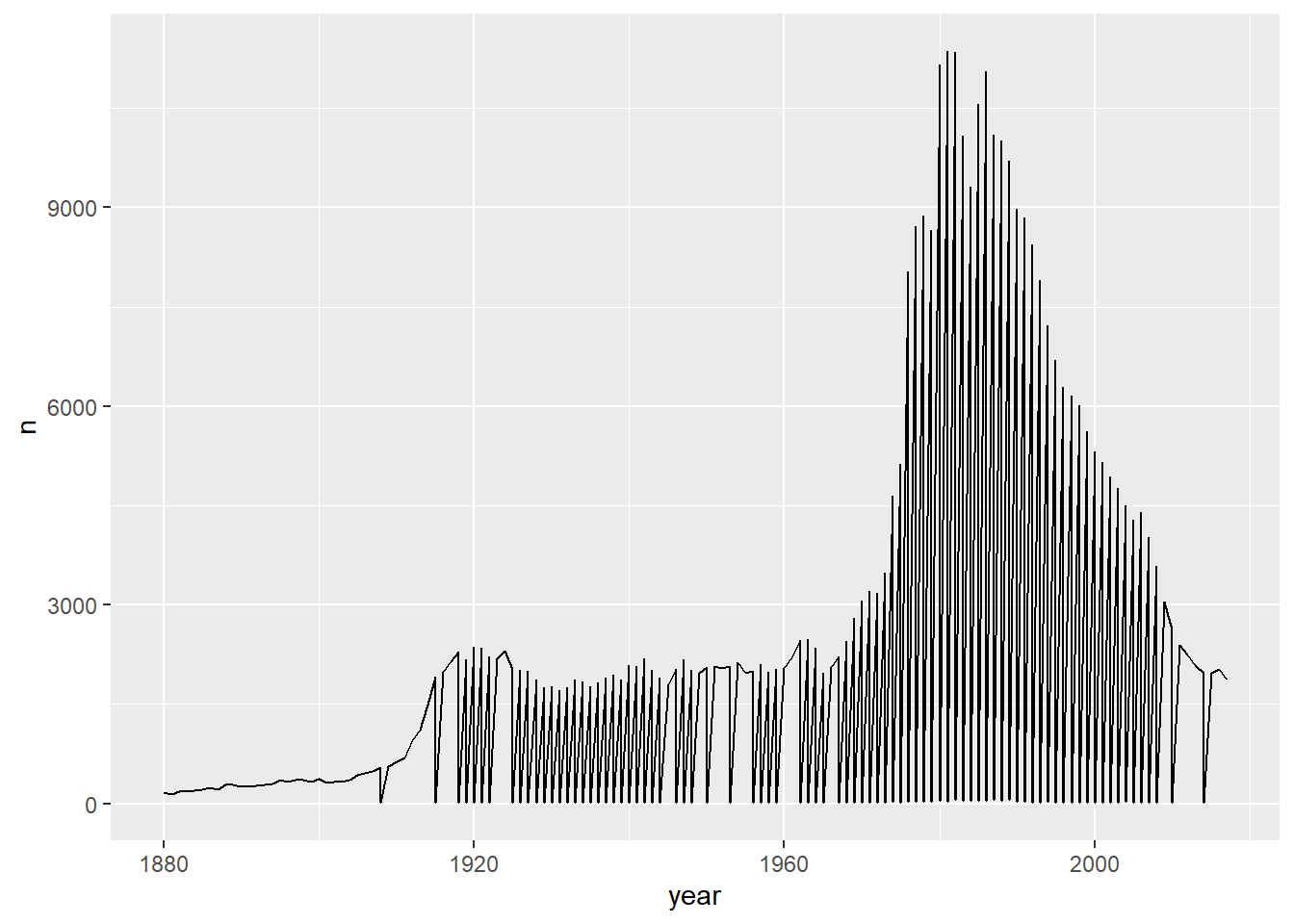
babynames %>%filter (name =="Sara")
# A tibble: 222 × 5
    year sex   name      n    prop
   <dbl> <chr> <chr> <int>   <dbl>
 1  1880 F     Sara    165 0.00169
 2  1881 F     Sara    147 0.00149
 3  1882 F     Sara    180 0.00156
 4  1883 F     Sara    183 0.00152
 5  1884 F     Sara    197 0.00143
 6  1885 F     Sara    215 0.00151
 7  1886 F     Sara    247 0.00161
 8  1887 F     Sara    214 0.00138
 9  1888 F     Sara    293 0.00155
10  1889 F     Sara    286 0.00151
# ℹ 212 more rows